Fred & Fly
Assessment of 4 ideas put forward by the owner to improve marketing and sales performance.
- Experiments
- None
- Timeframe
- 1 week
- Price
- €990 excl. VAT
I’m Xavier Herman. I’ve spent my career on the digital transformation of companies: first on the agency side, for brands such as Audi, Nike, Nestlé, Nissan, Canal+ and Club Med, then from the inside, as head of digital for Derichebourg Multiservices and Caudalie.
That was then. Today I sit down with SME owners and tell them where AI will pay off, and where it won’t, in their particular context.
The findings are yours either way.
Programmes run for large groups and, today, for companies of up to fifty people, depending on the sector.

What I hear
This is what I hear, almost word for word, from nearly everyone I talk to.
I probably need to invest in AI. I don’t understand what’s happening in this market, what I can actually do, or where to put my money so it actually pays off.
And among those who have already invested, many have been disappointed: trials, subscriptions, but a return that’s hard to measure.
Ask it to do too much and it’ll hurt your business. Hand it the keys without a real process and it won’t work at all. That may change eventually. Right now, AI isn’t self-sufficient.
Applied to a repetitive, well-defined and measurable task, it saves time every day, and those gains add up.
Applied to a fuzzy or poorly controlled process, it adds work instead of removing it, and the mistake costs you.
My job: telling the two apart, before you invest.
The question isn’t which tool to buy. It’s where, in your business, a euro invested in AI pays off.
The engagement
I go through your business with the people who run it, then come back with a written roadmap. It ranks where AI would return the money, and names what won’t work.
For you: one or two focused working sessions for each person involved (sometimes just the owner), then a findings meeting. Nothing more.
For me: a few days, including the technical experiments needed.
You get a Project Reference Document: comparative scenarios, CAPEX and OPEX costing, a clear go or no-go on each option, and a roadmap. We go through it together, I answer your questions, and you have what you need to decide.
Sometimes an idea is a bad one, or too risky, and I’ll say so. What you get is my own read, not a universal or theoretical formula.
You work directly and only with me at every stage, from drafting a tailored engagement proposal to presenting the conclusions.
Your team has no shared picture of AI yet. We start with a day with your management team: the state of the art, what’s possible now, how an AI project runs.
You already know what you want fixed. We answer whether it can be done and whether it’s worth doing, and check what sits next to it.
Everyone has a project and you can’t fund them all. We rank them. Some rank last, on purpose.
All three end in the same place: a plan that says where the return is.
The AI Blueprint comes in two formats: with or without an experimentation track. We decide together at the proposal stage.
The field frictions, where time and money are being lost.
The possible AI levers, matched against each friction identified.
Comparative scenarios, CAPEX and OPEX costing, go or no-go, roadmap.
Mapping how orders, data and decisions really move through the business. Auditing the field workflow and the systems around it, then formalising a target picture.
Sandboxing the candidate options on your own material, and benchmarking several models against each use case to see which one performs and what it costs to run.
When both tracks are planned, they start in week one and their findings cross over as they land.
From €990 excl. VAT. Quoted in a tailored proposal after a first meeting.
Assessment of 4 ideas put forward by the owner to improve marketing and sales performance.
How can AI help reduce restocking times across more than 600 points of sale?
How can AI help improve operational profitability?
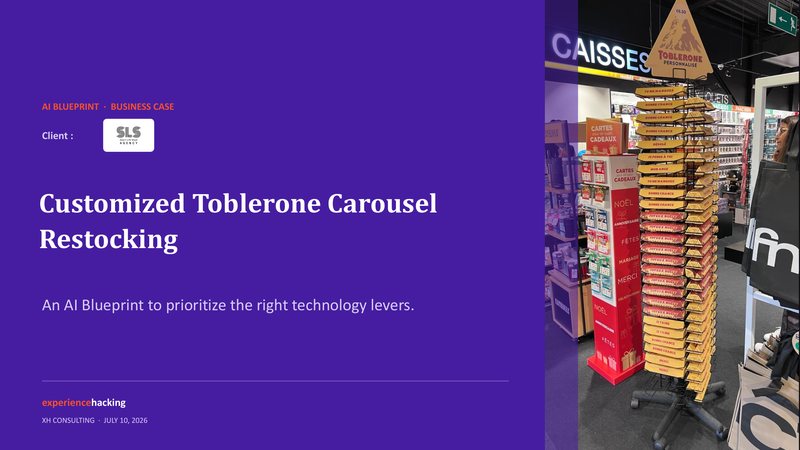
Case study · SLS Agency
An AI Blueprint to prioritise the right technology levers, across more than 600 points of sale in France.
“The AI Blueprint led by Xavier allowed us to pragmatically clarify a central operational challenge for one of our consumer brands: accelerating and streamlining restocking across our 600 points of sale. […] His approach, combining business analysis, feasibility testing, and deployment scenarios, gives us a solid foundation today to decide on our next investments.”
The findings are yours either way. No further work together, and you still keep the roadmap.
Start with the AI BlueprintWorking with owners
In a large group the AI decision sits behind a programme office. Months of process, a dozen people with a view, and by the time anyone commits the market has moved and the budget is half spent on getting organised.
You don’t have that problem. The person carrying the AI question is the person who can act on it, which means we can go straight to the part that matters: what this would cost, what it would return, and what to walk away from.
Not a strategy exercise. A short, direct answer on where your money deserves to be invested.
Is this you
0 of 7 tickedTwo is enough.
Two were enough. The plan above answers all of them.
Already have a data or AI team? You don’t need me to tell you where to look.
Already picked your project and just need it built? Different job, not this one.
The next step
The Blueprint takes one to four weeks, depending on format. The findings are yours whether or not anything follows. The first conversation costs nothing.
Or write to me. No formal process.
The shorter question
There’s a shorter version: five minutes, free, no call. Describe one thing that isn’t working, get a first read on whether AI is worth pointing at it.
Same question the Blueprint answers, asked quickly. Lives on experiencehacking.eu, where the method sits.
From the other side
“Before meeting him, I told myself ‘this isn’t for me’… how could a communications agency benefit from expertise like his? Then his diagnosis landed like a revelation: on B2B marketing and selling our services, we simply weren’t equipped!”
“Bottom line: advice that was more than useful, for a clear plan of action within our reach.”
“A second very positive experience with Xavier. His grasp of technology and marketing, and of applying technology within marketing, is helping us with Carbase’s transformation. His advice, his foresight, his pragmatism, and his ability to explain things clearly all make Xavier an outstanding professional who is a pleasure to work with.”
“Xavier worked as a freelancer for my mobile agency. The outcome of his work was outstanding. He is one of the very few who understands extremely well technology, innovation and marketing! And the cherry on the cake is that my team liked working with him more than with any other freelancers!”
Questions owners ask
The AI Blueprint is a diagnostic for the owner of a small or mid-sized company. It says where AI would return money in your business, and where it would not, before any budget is committed. It ends in a written, ranked plan.
From €990 excluding VAT. Scope sets the fee: the SLS Agency engagement, a two-track Blueprint across more than 600 points of sale, ran at €5,400 excluding VAT. You get an estimate before anything starts, and the first conversation costs nothing.
One to four weeks, depending on format (with or without an experimentation track) and scope. On your side: one or two working sessions for each person involved, then a findings meeting.
It’s a recommendation I make at the proposal stage, and you decide. Experimentation becomes useful when an AI option falls outside standard uses or carries technical risk, when you want a precise estimate of the running costs of a project that makes heavy use of AI models, or when several models need to be compared. Otherwise, the analysis is enough.
A Project Reference Document: comparative scenarios, CAPEX and OPEX costing, a clear go or no-go on each option tested, and a roadmap. It is yours to keep, whether or not we work together afterwards.
Companies of ten to fifty people, depending on the sector, where the owner carries the AI question. It is not for companies that already have a data or AI team, or for projects that are already chosen and only need building.
The decision comes before the spending. The Blueprint tests the options on your own material and costs them before you buy anything, and “no” is one of the possible answers.
If a next step makes sense, including one I could build myself, I will say so plainly. If it doesn’t, I will say that too. The ranking is my own read on the numbers: an estimate, not a universal formula.
Yes. The five-minute check on experiencehacking.eu is free and needs no call: describe one thing that isn’t working and get a first read on whether AI is worth pointing at it.
The AI Blueprint. One to four weeks depending on format, one ranked plan.
Start with the AI Blueprint